
Dambadeniya Sri Wijayasundararamaya
Dambadeniya kingdom came in to existence with the fall of Polonnaruwa kingdom to Kalinga Maga in the 13th century and a new king Vijayabahu III (also known as Vathhimi Vijayabahu) established his kindom under the protection of the Dambadeniya Rock in 1232. Along with this shift the Tooth Relic was too moved to Dambadeniya.
It is believed that 2 relic houses were built at this kingdom, one at the top of the Dambadeniya rock where the palace was built and the other in the inner city which is now the Sri Wijayasundararamaya Rajamaha Viharaya.
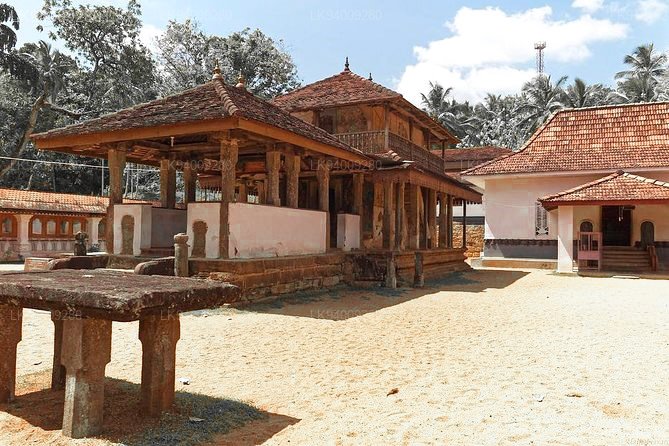
The Tampita Viharaya at the Sri Wijayasundararamaya is believed to be the ancient relic house of the Dambadeniya kingdom.
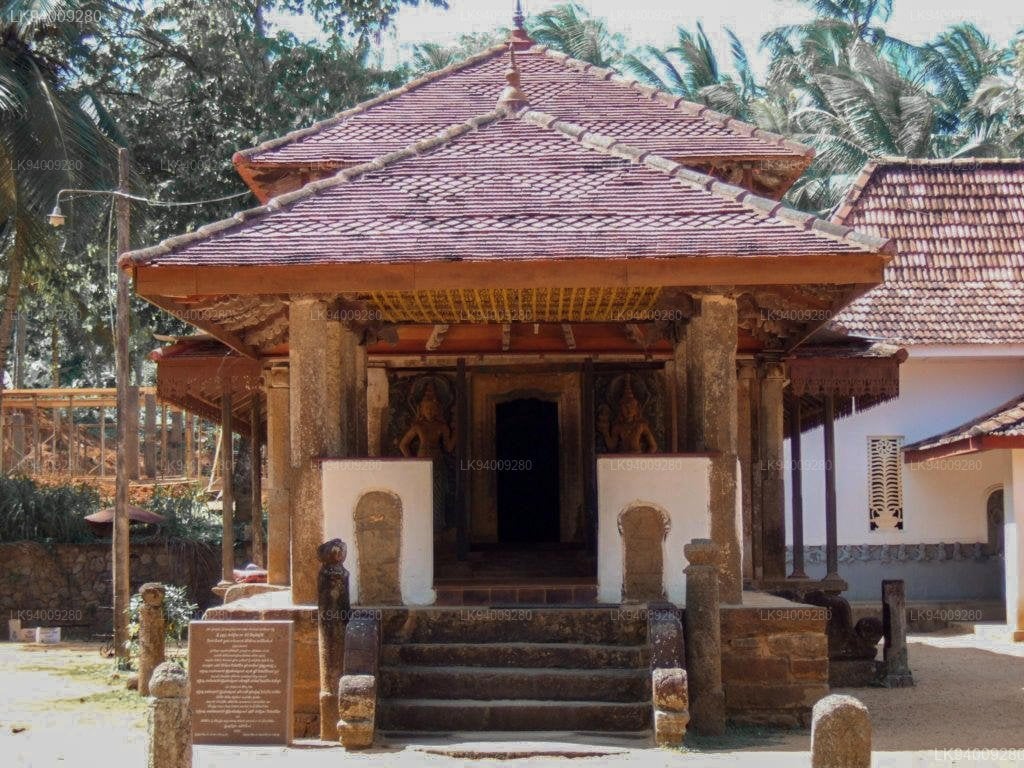
All the religious buildings of the temple is built on a higher ground and a flight of granite steps are built towards this terrace. The steps ends at a Vahalkada . This is built on four rock pillars with a square roof. The entrance is a large door frame made of granite. It is believed that this was the Eastern Entrance to the inner city of the Dambadeniya Kingdom.
The Tampita Viharaya found on this terrace has been identified as the Relic House, 3 storied high built by king Parakramabahu II (1244 -1279), son of Vijayabahu III. This has been converted to a 2 storied Tampita Viharaya by Meegasthanne Adhikaram also known as the Dumbara Maha Nilame during the reign of king Sri Wikrama Rajasinhe (1798 – 1815).
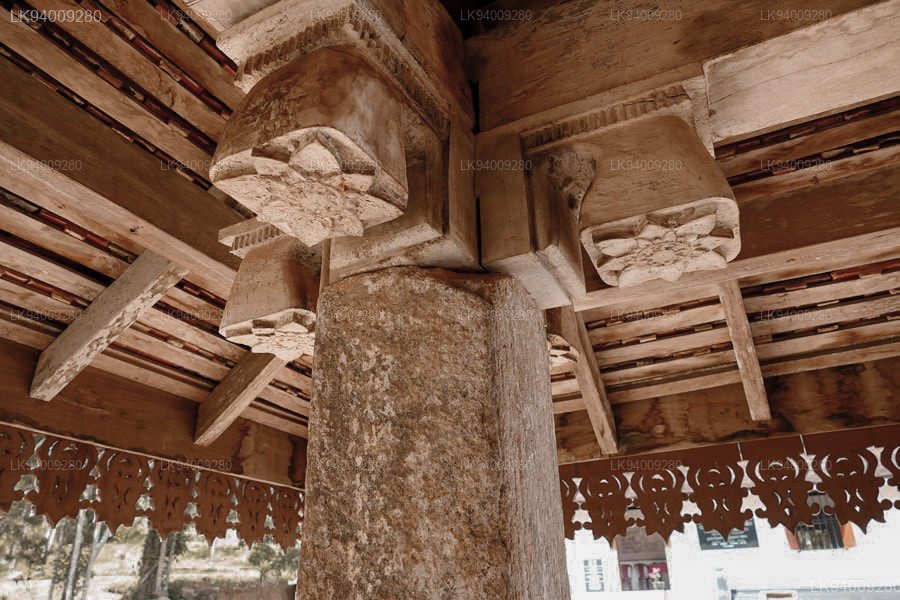
The Tampita Viharaya is built on a raised platform made of stone. This platform is 18 feet 6 inches long and 11 feet 11 inches wide. A 3 feet wide circumambulating path is build around the ground floor image house. Entrance to this image house is through a large wooden door frame built in the Chandrawanka form. Statues of two guardian deities carrying a flower pot stand beside the entrance. A Hansa Pututuwa painting can be seen at the top of the door frame. The paintings around the door frame has lost its archaeological significance due to recent renovations. A seated Buddha statue is found inside the image house. This statue is flanked by 2 standing Buddha statues.
A wooden flight of steps leads to the image house on the second floor. The second floor is built on 14 granite pillars and 12 wooden pillars. The image house is 29 feet long and 19 feet wide. A 2 feet 2 inch wide circumambulating path goes all around the relic house. A wooden balustrade is built around the path. Similar to the ground floor two Nagaraja guardian deities carrying a flower pot stand beside the entrance to the relic house.
A painting of the Meegasthanne Adhikaram and Parakramabahu II can be seen among the murals inside the image house. The subject of the murals in this chamber lean towards the Tooth Relic of Buddha. A exquisite mural of the Dalada Perahera can be also found in this chamber. An elephant leads the prossesion and and the tooth relic is carried on a Palanquin and the king can be seen worshiping